Friday, October 16, 2020

Foreign Language

 Foreign Language

2020/10/26

移到十月

-----


https://pixabay.com/zh/photos/airport-board-flying-scoreboard-1890943/

-----


Foreign Languages


◎ 第一語言與第二語言

◎ 三大類語言

- 屈折語:拉丁文

- 膠著語:日文

- 孤立語:英文

-- Crocodile vs. Alligator

◎ 聽、讀、說(朗讀與跟述)、寫(Free Writing)

-----


左腦與右腦

◎ 右腦發達的人對所接收的訊息,是用符號、圖像,或圖案來記憶,因此可以一次記住大量的訊息。如同使用相機拍成照片再處理成影像及圖案,作為記憶。此外,右腦發達的人在感受外界的五感(視聽嗅觸味五覺)刺激時,會依照當下的感受留存記憶,這也是右腦的特性之一。因此,右腦是屬於圖像腦

◎ 右腦型的人,發揮情感、欣賞藝術的腦細胞集中在右半球。知覺和想像力較強、高創造性、不拘泥於局部分析,往往會統觀全局及大膽猜測,是屬於直覺型結論。

◎ 左腦發達的人,記憶時並不是依據圖案,而是用文字語言來熟稔,對牢記背誦的科目較為擅長。對於五感的刺激,會將當時的感受轉化為言語並留存記憶,因此,左腦是屬於言語腦

◎ 左腦型的人,理解數學和語言的腦細胞集中在左半球。處理事情比較有邏輯、條理,社交場合上較活躍,善於組織、統計、方向感強。判斷各種關係和因果 善於做技術類、抽象等工作。

https://www.chinatimes.com/realtimenews/20151005004166-260405?chdtv

-----


https://www.vectorstock.com/royalty-free-vector/human-brain-anatomy-card-poster-vector-20498832

-----


https://www.vectorstock.com/royalty-free-vector/cartoon-human-brain-anatomy-in-a-cut-vector-13237286

-----


第一語言與第二語言

「1997 年一個雙語實驗顯示:第一和第二語言大腦處理的區塊不相同,尤其第二語言的區域更是因人而異。實驗者給法文為母語,英文為第二語言的受試者聽法文和英文的故事,同時做核磁共振的大腦掃瞄,結果發現第一語言都在左腦的顳葉處理」,右邊的顳葉雖然也有活化,但是活化程度大不如左。但是第二語言學習的區域就很不一致了,在他的八位男性受試者中(都是7歲以後開始學英文)找不到一個至少六個人有共同處的地方,第二語言的處理都轉到右腦去了」,即使左腦有活化也遠比右腦弱。也就是說,第一語言的學習通常是左腦皮質的任務,但是第二語言會因每個人的學習策略而異。」

https://parents.hsin-yi.org.tw/Library/Article/5609

https://blog.xuite.net/tcpang/twblog/157224124-%E5%BE%9E%E5%A4%A7%E8%85%A6%E7%A5%9E%E7%B6%93%E7%A7%91%E5%AD%B8%E7%9A%84%E8%A7%92%E5%BA%A6%E7%9C%8B%E8%AA%9E%E6%96%87%E5%AD%B8%E7%BF%92

-----

https://nihongokyoiku-shiken.com/type-of-language-viewed-from-morphological-typology/

-----


-----


-----


-----


-----

印歐語族


-----


http://dcc.dickinson.edu/grammar/latin/case-endings-five-declensions

-----


https://www.pinterest.com/pin/119767671312510959/

-----


https://www.amazon.com/Getting-Started-Latin-Homeschoolers-Self-Taught/dp/0979505100

-----


https://www.aozora.gr.jp/

-----


https://taiwan.kinokuniya.com/bw/9789579926300

-----


https://www.amazon.co.jp/%E3%83%99%E3%83%8D%E3%83%83%E3%82%BB%E6%96%B0%E4%BF%AE%E5%9B%BD%E8%AA%9E%E8%BE%9E%E5%85%B8-%E7%AC%AC%E4%BA%8C%E7%89%88-%E4%B8%AD%E9%81%93-%E7%9C%9F%E6%9C%A8%E7%94%B7/dp/4828865683/ref=sr_1_1?__mk_ja_JP=%E3%82%AB%E3%82%BF%E3%82%AB%E3%83%8A&dchild=1&keywords=%E3%83%99%E3%83%8D%E3%83%83%E3%82%BB+%E5%9B%BD%E8%AA%9E%E8%BE%9E%E5%85%B8&qid=1603415182&sr=8-1

-----


https://jp.sonic-learning.com/2016/06/07/seiri/

-----


http://aozoraroudoku.jp/index.html

-----


如何學好英文 

大概就是幾個要點: 


一:成寒,從聽力開始。 

二:鄭贊容,除了聽力以外,要知道學習型辭典。 

三:George Chen,學習型辭典詳解。 

四:六本學習型辭典。 

五:Crocodile 在六本學習型辭典中的解釋。 

六:柳林中的風聲簡易版。 

七:柳林中的風聲完整版。

-----


https://tw.bid.yahoo.com/item/%E8%BA%BA%E8%91%97%E5%AD%B8%E8%8B%B1%E6%96%87%E9%99%84%E7%A2%9F%E6%99%82%E5%A0%B1%E5%87%BA%E7%89%88%E6%88%90%E5%AF%92%E8%91%97%E8%81%BD%E5%8A%9B%E5%BE%9E%E9%9B%B6%E5%88%B0%E6%BB%BF%E5%88%862003%E5%B9%B413-100856578605

-----


https://shopee.tw/%E3%80%90%E5%A4%A7%E9%A0%AD%E8%B2%93%E5%95%86%E9%8B%AA%E3%80%91%E3%80%8A%E7%B5%95%E7%89%88%E4%BA%8C%E6%89%8B%E6%9B%B8%E3%80%8B%E9%81%A0%E6%B5%81-%E5%8D%83%E8%90%AC%E5%88%A5%E5%AD%B8%E8%8B%B1%E8%AA%9E-%E9%84%AD%E8%B4%8A%E5%AE%B9-%E5%8F%A4%E8%91%A3-%E6%94%B6%E8%97%8F-%E6%9B%B8%E7%B1%8D-book-%E7%A6%AE%E7%89%A9-%E6%AD%A3%E7%89%88-%E7%8F%BE%E8%B2%A8-%E3%80%8E%E9%99%90%E6%99%82%E5%85%8D%E9%81%8B%E3%80%8F-i.33211563.3156336644

-----


http://georgechen.tw/?page_id=21

-----

圖廿六。

六本學習型辭典。

-----

圖廿七。

右一到右四是大學辭典。右五是發音辭典。右六與右七是圖解辭典。

-----


https://www.youtube.com/watch?v=lpC7MnHmNqE

-----


https://www.amazon.co.uk/Macmillan-English-Dictionary-Advanced-learners/dp/1405026286

-----


http://georgechen.idv.tw/wordpress/?p=1561

-----


https://www.amazon.co.uk/Longman-Dictionary-Contemorary-English-Contemporary/dp/1405811269

-----


http://georgechen.idv.tw/wordpress/?p=1561

-----


https://www.pinterest.com/pin/454652524852056658/

-----


https://onepiece.fandom.com/zh/wiki/%E6%B2%99%C2%B7%E5%85%8B%E6%B4%9B%E5%85%8B%E9%81%94%E7%88%BE?variant=zh-sg

-----


Crocodile vs. Alligator

學英文儘量不要查字典。真要查,就查多一點。

1 到 6 是學習型辭典,以 2000 到 3000 字,定義字典裡的所有單字,適合母語非英語的學習者。7 到 10 是大學辭典,適合英美一般大學生或成人。

1. Collins COBUILD. 圖廿六,左一。

2. Macmillan. 圖廿六,左二。

3. Cambridge. 圖廿六,左三。

4. Longman. 圖廿六,左四。

5. Oxford. 圖廿六,左五。

6. Merriam-Webster. 圖廿六,左六。

7. Oxford. 圖廿七,右二。

8. Merriam-Webster. 圖廿七,右一。

9. Webster's New World. 圖廿七,右三。

10.  Houghton Mifflin. 圖廿七,右四。

-----


◎ Crocodile 的解釋一:

1. A crocodile is a large reptile with a long body and stronger jaws. Crocodiles live in rivers and eat meat.

2. A crocodile is a large reptile that lives in water in hot countries. It has a long body and a long mouth with many sharp teeth.

3. A crocodile is a large reptile with a hard skin that lives in and near rivers in the hot wet parts of the world. It is like an alligator, but it usually has a longer and narrower nose.

4. A crocodile is a large reptile with a hard skin that lives in and near rivers in the hot wet parts of the world.

5. A crocodile is a large reptile with a long tail, hard skin and very big jaws. Crocodiles live in rivers and lakes in hot countries.

6. A crocodile is a large reptile that has a long body, thick skin, and a long, thin mouth with sharp teeth and lives in the water in regions with hot weather.

以上是學習型辭典。

-----


◎ Crocodile 的解釋二:

7. A crocodile is a large predatory semiaquatic reptile with long jaws, long tail, short legs, and a horny texture skin.

8. A crocodile is any of several large carnivorous thick-skinned long-bodied aquatic reptiles of tropical and subtropical waters.

9. A crocodile is any of a subfamily (Crocodylinae) of large, flesh-eating, lizardlike crocodilan reptiles living in or around tropical streams and having thick, horny skin composed of scales and plates, a long tail, and a long, narrow, triangular head with massive jaws: it has on each side of the lower jaw a large tooth that protrudes upward from its closed mouth.

10. A crocodile is any of large aquatic reptiles, chiefly of the genus Crocodylus, native to tropical and subtropical regions and having thick armorlike skin and long tapering jaws. 

以上是大學辭典。

-----


◎ Alligator 的解釋一:

1. An alligator is a large reptile with short legs, a long tail and very powerful jaws.

2. An alligator is a large reptile with a long tail, four short legs, a long pointed mouth, and sharp teeth that lives in parts of the US and China.

3. An alligator is a large reptile with a hard skin that lives in and near rivers and lakes in the hot wet parts of America and China. It has a long nose that is slightly wider and shorter than that of a crocodile.

4. An alligator is a large animal with a long mouth and tail and sharp teeth and lives in the hot wet parts of the US and China.

5. An alligator is a large reptile similar to a crocodile, with a long tail, hard skin and very big jaws, that lives in rivers and lakes in N and S America and China.

6. An alligator is a large reptile that has a long body, thick skin, and sharp teeth, that lives in the tropical parts of the U.S. and China, and that is related to crocodiles.

以上是學習型辭典。

-----


◎ Alligator 的解釋二:

7. An alligator is a large semiaquatic reptile similar to a crocodile but with a broader and shorter head, native to Americas and China.

8. Either of two crocodilans (Alligator mississipiensis of the southeastern U.S. and A. sinensis of China) having broad heads not tapering to the snout and a special pocket in the upper jaw for reception of the enlarged lower forth tooth.

9. An alligator is any of a genus (Alligator) of large crocodilan reptiles found in tropical rivers and mashes of the U.S. and China: its snout is shorter and blunter than the crocodile's, and its teeth do not protrude outside its closed mouth.

10. An alligator is either of two large reptiles, Alligator mississipiensis of the southeast United States or A. Sinensis of China, having sharp teeth, powerful jaws, and a broader, shorter snout than the crocodile.

以上是大學辭典。

-----


https://www.crane.com.tw/Book/Detail?bokid=1700005&vtmc=0010

-----


https://librivox.org/the-wind-in-the-willows-by-kenneth-grahame-3/

-----


朗讀

http://hugoscorner.blogspot.com/2017/03/reader.html

-----


跟述

https://dotblogs.com.tw/Funny_DotBlog/2020/06/23/cln_Interpreter_1

-----


Free Writing

https://www.thebalancecareers.com/how-does-a-writer-freewrite-we-ll-show-you-how-1277733

-----

Thursday, October 15, 2020

[翻譯] 5 algorithms to train a neural network

[翻譯] 5 algorithms to train a neural network

2020/10/02

-----


https://www.neuraldesigner.com/blog/5_algorithms_to_train_a_neural_network

Fig. 1. 5 algorithms to train a neural network。

-----

The procedure used to carry out the learning process in a neural network is called the optimization algorithm (or optimizer).

用於在神經網路中執行學習過程的過程稱為優化算法(或優化器)。

There are many different optimization algorithms. All have different characteristics and performance in terms of memory requirements, processing speed, and numerical precision.

有許多不同的優化算法。 就內存需求,處理速度和數值精度而言,所有算法都有不同的特性和表現。

In this post, we formulate the learning problem for neural networks. Then, some important optimization algorithms are described. Finally, the memory, speed, and precision of those algorithms are compared.

在這篇文章中,我們制定了神經網路的學習問題。 然後,描述了一些重要的優化算法。 最後,比較了這些算法的內存,速度和精度。

-----


https://www.neuraldesigner.com/blog/5_algorithms_to_train_a_neural_network

Fig. 2. 5 algorithms to train a neural network。

-----

Learning problem.

1. Gradient descent.

2. Newton method.

3. Conjugate gradient.

4. Quasi-Newton method.

5. Levenberg-Marquardt algorithm.

Performance comparison.

Conclusions.

學習問題。

1. 梯度下降。

2. 牛頓法。

3. 共軛梯度。

4. 擬牛頓法。

5. 萊文貝格-馬夸特方法。

性能比較。

結論。

Neural Designer implements a great variety of optimization algorithms to ensure that you always achieve the best models from your data. You can download a free trial here.

Neural Designer 實現了各種各樣的優化算法,以確保您始終從數據中獲得最佳模型。 您可以在此處下載免費試用版。

-----

Learning Problem

-----

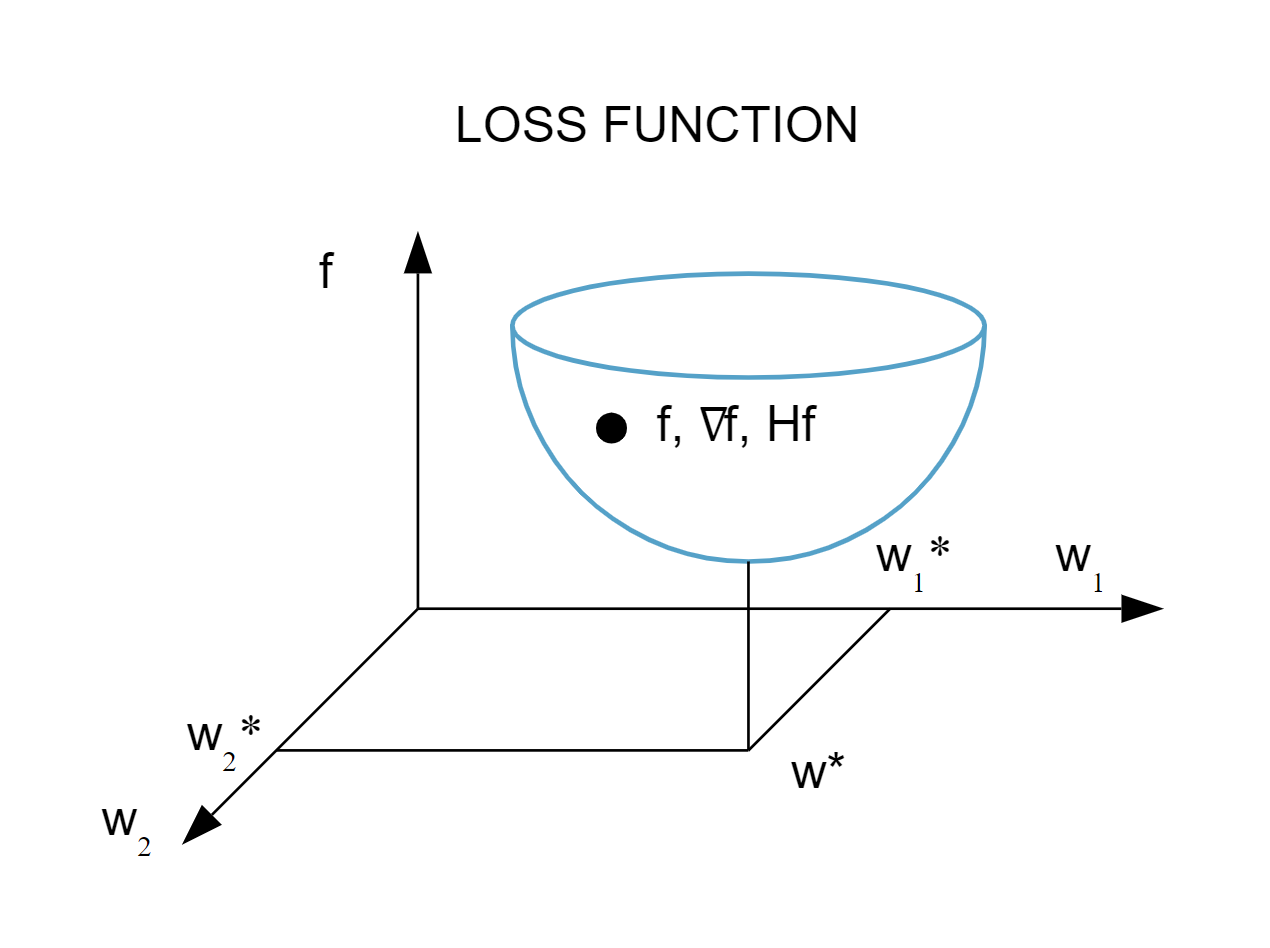
The learning problem is formulated in terms of the minimization of a loss index, f. It is a function that measures the performance of a neural network on a data set.

學習問題是根據損耗指數 f  的最小化來表述的。 它是一項測量數據集上神經網路性能的函數。

The loss index is, in general, composed of an error and a regularization terms. The error term evaluates how a neural network fits the data set. The regularization term is used to prevent overfitting by controlling the sufficient complexity of the neural network.

損耗指數通常由錯誤和正則項組成。 誤差項評估神經網路如何擬合數據集。 正則化項用於通過控制神經網路的足夠複雜性來防止過度擬合。

The loss function depends on the adaptative parameters (biases and synaptic weights) in the neural network. We can conveniently group them into a single n-dimensional weight vector w.

損失函數取決於神經網路中的自適應參數(偏置和突觸權重)。 我們可以方便地將它們分組為單個 n 維權重向量 w。

The picture below represents the loss function f(w).

下圖顯示了損失函數 f(w)。

-----


Fig. 3. Loss Function。

-----


Fig. 4. The first derivatives。

-----

As we can see in the previous picture, the minimum of the loss function occurs at the point w∗. At any point A, we can calculate the first and second derivatives of the loss function.

如上圖所示,損失函數的最小值出現在 w * 點。 在任何一點 A,我們都可以計算損失函數的一階和二階導數。

The first derivatives are grouped in the gradient vector, whose elements can be written as ... for i = 1, … , n.

一階導數在梯度向量中分組,對於 i = 1,…,n,其元素可以寫成 ...。

Similarly, the second derivatives of the loss function can be grouped in the Hessian matrix, for i, j = 0, 1, … .

類似地,對於 i,j = 0,1,…,損失函數的二階導數可以分組在 Hessian 矩陣中。

The problem of minimizing the continuous and differentiable functions of many variables has been widely studied. Many of the conventional approaches to this problem are directly applicable to that of training neural networks.

最小化多變量的連續和可微函數的問題已被廣泛研究。 解決該問題的許多常規方法可直接應用於訓練神經網路。

-----

One-dimensional optimization

-----

Although the loss function depends on many parameters, one-dimensional optimization methods are of great importance here. Indeed, they are very often used in the training process of a neural network.

儘管損失函數取決於多參數,但是一維優化方法在這裡非常重要。 確實,它們經常在神經網路的訓練過程中使用。

Many training algorithms first compute a training direction d  and then a training rate η; that minimizes the loss in that direction, f(η). The next picture illustrates this one-dimensional function.

許多訓練算法首先計算訓練方向 d,然後計算訓練速率 η; 從而使該方向上的損耗 f(η)最小。 下一張圖片說明了此一維函數。

-----


Fig. 5. Interval。

-----

The points η1 and η2 define an interval that contains the minimum of f, η∗.

點 η1 和 η2 定義了一個包含 f 的最小值 η∗ 的區間。

In this regard, one-dimensional optimization methods search for the minimum of a given one-dimensional function. Some of the algorithms which are widely used are the golden section method and Brent's method. Both reduce the bracket of a minimum until the distance between the two outer points in the bracket is less than a defined tolerance.

在這方面,一維優化方法搜索給定一維函數的最小值。 廣泛使用的一些算法是黃金分割法和布倫特法。 兩者都會減小區間中的最小值,直到區間中兩個外部點之間的距離小於定義的公差為止。

-----

Multidimensional optimization

-----

The learning problem for neural networks is formulated as searching of a parameter vector w∗ at which the loss function f takes a minimum value. The necessary condition states that if the neural network is at a minimum of the loss function, then the gradient is the zero vector.

神經網路的學習問題被表述為搜索參數向量 w∗,其中損失函數 f 取最小值。 必要條件表明,如果神經網路處於損失函數的最小值,則梯度為零向量。

The loss function is, in general, a non-linear function of the parameters. As a consequence, it is not possible to find closed training algorithms for the minima. Instead, we consider a search through the parameter space consisting of a succession of steps. At each step, the loss will decrease by adjusting the neural network parameters.

損失函數通常是參數的非線性函數。 結果,不可能找到針對最小值的封閉訓練算法。 相反,我們考慮在由一系列步驟組成的參數空間中進行搜索。 在每一步,通過調整神經網路參數,損耗將減少。

In this way, to train a neural network, we start with some parameter vector (often chosen at random). Then, we generate a sequence of parameters, so that the loss function is reduced at each iteration of the algorithm. The change of loss between two steps is called the loss decrement. The training algorithm stops when a specified condition, or stopping criterion, is satisfied.

這樣,為了訓練神經網路,我們從一些參數向量開始(通常是隨機選擇)。 然後,我們生成一系列參數,以便在算法的每次迭代中減少損失函數。 兩步之間的損耗變化稱為損耗減量。 當滿足指定條件或停止標準時,訓練算法停止。

-----

1. Gradient descent

-----

Gradient descent, also known as steepest descent, is the most straightforward training algorithm. It requires information from the gradient vector, and hence it is a first-order method.

梯度下降,也稱為最速下降,是最直接的訓練算法。 它需要來自梯度向量的信息,因此它是一階方法。

-----


Fig.

-----

The parameter η is the training rate. This value can either set to a fixed value or found by one-dimensional optimization along the training direction at each step. An optimal value for the training rate obtained by line minimization at each successive step is generally preferable. However, there are still many software tools that only use a fixed value for the training rate.

參數 η 是訓練率。 該值可以設置為固定值,也可以在每一步沿訓練方向通過一維優化找到。 通常優選在每個連續步驟通過線最小化獲得的訓練速率的最佳值。 但是,仍然有許多軟體工具僅將固定值用於訓練率。

The next picture is an activity diagram of the training process with gradient descent. As we can see, the parameter vector is improved in two steps: First, the gradient descent training direction is computed. Second, a suitable training rate is found.

下一張圖片是梯度下降訓練過程的活動圖。 可以看到,參數向量在兩個步驟中得到了改進:首先,計算梯度下降訓練方向。 第二,找到合適的訓練率。

-----


Fig.

-----

The gradient descent training algorithm has the severe drawback of requiring many iterations for functions which have long, narrow valley structures. Indeed, the downhill gradient is the direction in which the loss function decreases the most rapidly, but this does not necessarily produce the fastest convergence. The following picture illustrates this issue.

梯度下降訓練算法具有嚴重的缺點,即對於具有長而窄的谷底結構的函數,需要進行多次迭代。 確實,下坡是損失函數下降最快的方向,但這並不一定會產生最快的收斂。 下圖說明了此問題。

-----


----

References

[1] 5 algorithms to train a neural network

https://www.neuraldesigner.com/blog/5_algorithms_to_train_a_neural_network

[2] 從梯度下降到擬牛頓法:詳解訓練神經網絡的五大學習算法_機器之心 - 微文庫

https://www.luoow.com/dc_hk/108919053

[3] 從梯度下降到擬牛頓法:詳解訓練神經網絡的五大學習算法 - 每日頭條

https://kknews.cc/zh-tw/tech/p8nq8x8.html

-----